
Types of Chinese noodles explained: from lamian to dao xiao mian
Published: April 29, 2026
Short Answer
China has over 400 distinct noodle varieties, each region developing its own shape, texture, and preparation method. The main types include hand-pulled lamian (兰州拉面), knife-cut dao xiao mian (刀削面), dan dan noodles from Sichuan, and Beijing's zhajiangmian — each reflecting local ingredients, climate, and culinary philosophy.
A bowl of hand-pulled noodles in clear broth with green vegetables
Advertisement
Deep Dive
The Great Noodle Divide: North vs South
China's noodle culture splits along a fundamental line: wheat noodles dominate the north, rice noodles rule the south. This mirrors the agricultural divide where wheat grows in the dry northern plains and rice thrives in the wet southern paddies. Northern noodles are chewy, elastic, and served with hearty, savory sauces. Southern noodles tend to be silky, slippery, and served in light broths or stir-fried at high heat. Understanding this divide is the first step to navigating China's vast noodle landscape.
Hand-Pulled Noodles (兰州拉面, Lāmiàn)
The most famous Chinese noodle technique is lamian — hand-pulled noodles from Lanzhou, Gansu province. A skilled noodle master takes a lump of dough and, through a series of stretching, folding, and twisting motions, transforms it into dozens of thin, uniform strands in under two minutes. The dough is made with flour, water, salt, and an alkaline agent (蓬灰, péng huī) that gives the noodles their distinctive yellow hue and chewy elasticity. Lanzhou lamian is served in a clear beef broth with sliced beef, radish, chili oil, cilantro, and garlic sprouts. The noodle width can be specified by the customer — from hair-thin (毛细, máo xì) to wide flat strips (大宽, dà kuān).
Knife-Cut Noodles (刀削面, Dāo Xiāo Miàn)
From Shanxi province comes dao xiao mian — noodles shaved directly from a block of dough into boiling water with a flat blade. The noodles are irregular, thick in the middle and thin at the edges, creating a satisfying chewy-yet-slippery texture. Watching a noodle shaver work is mesmerizing: they hold a slab of dough against their shoulder and flick the blade in rapid strokes, sending ribbons of dough arcing into a pot of boiling water ten feet away. These noodles are traditionally served with a tomato and egg sauce or a meat sauce with potatoes and beans.
Dan Dan Noodles (担担面)
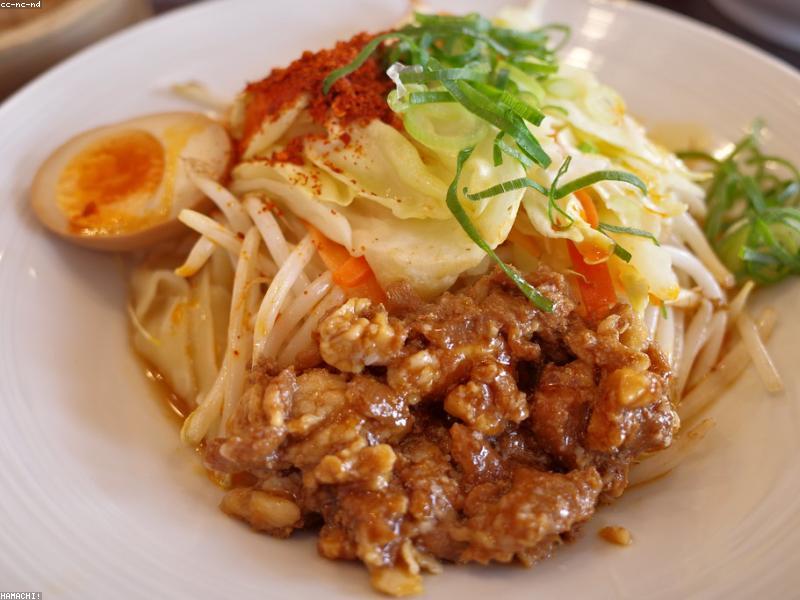
Sichuan's dan dan noodles are thin wheat noodles served with a sauce of sesame paste, chili oil, Sichuan peppercorn, preserved vegetables, and minced pork. The authentic Chengdu version is a "dry" noodle — the sauce clings to the noodles rather than sitting in a broth. The name comes from the carrying pole (扁担, biǎndan) that street vendors used to transport their kitchen on their shoulders. A proper dan dan noodle should hit five flavors simultaneously: salty, sweet, sour, spicy, and numbing.
Zhajiangmian (炸酱面, Zhǎjiàng Miàn)
Beijing's signature noodle is zhajiangmian — thick wheat noodles topped with a savory sauce of fermented soybean paste (黄豆酱) fried with ground pork, served alongside an array of fresh vegetable toppings: shredded cucumber, bean sprouts, edamame, shredded radish, and garlic. The sauce is rich and salty; the vegetables provide freshness and crunch. Mixing everything together at the table — each person customizing their own bowl — is part of the ritual. This is Beijing's comfort food, eaten year-round in homes and small noodle shops across the capital.
Rice Noodles and Regional Specialties
Southern China's rice noodles (米粉, mǐfěn) are a world apart from wheat noodles. Guilin rice noodles (桂林米粉) are silky smooth, served in a complex pork-based broth. Crossing the Bridge Rice Noodles (过桥米线) from Yunnan arrive with a bowl of piping-hot broth and a tray of raw ingredients — sliced meat, quail eggs, vegetables — that you add yourself, cooking in seconds from the broth's residual heat. Kunming's small-portion rice noodles (小锅米线) are cooked individually in small copper pots. In the south, rice vermicelli (粉丝, fěnsī) appears in everything from stir-fries to hot pot, absorbing flavors while maintaining its slippery texture.