
Chinese calligraphy: art and meaning
Published: April 29, 2026
Short Answer
Chinese calligraphy (书法, shufa) is the art of writing Chinese characters with a brush and ink — but calling it "writing" is like calling a symphony "noise." It is one of the four essential arts of the Chinese scholar, alongside painting, the game of go, and the guqin (a stringed instrument). A person's calligraphy was historically considered a window into their character, and the practice remains deeply respected in Chinese culture today.
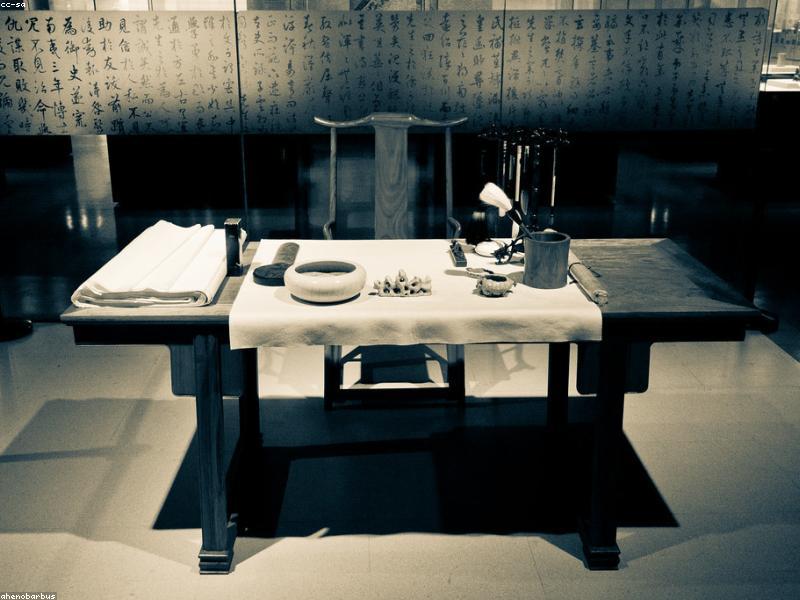
A calligrapher's workspace with ink stone, brush, rice paper, and a freshly written character
Advertisement
Deep Dive
The Four Treasures of the Study (文房四宝)
Every calligrapher's desk holds four essential tools, known as the Four Treasures of the Study (文房四宝, wenfang si bao):
- Brush (笔, bì) — Made from animal hair (wolf, goat, rabbit, or weasel) bound to a bamboo handle. The tip must be both supple and resilient. Different brushes produce different effects: wolf hair is stiff and good for fine lines; goat hair is soft and creates flowing, expressive strokes.
- Ink (墨, mò) — Traditionally, ink is a solid stick made from pine soot or oil soot mixed with animal glue. The calligrapher grinds the ink stick on the inkstone with water, controlling the concentration. Grinding ink is itself a meditative practice — many calligraphers say the process of preparing ink is as important as the writing.
- Paper (纸, zhǐ) — Xuan paper (宣纸) from Anhui province is the gold standard. It absorbs ink in a way that reveals every nuance of the brushstroke. The paper is thin, delicate, and unforgiving — you cannot erase or paint over mistakes.
- Inkstone (砚, yàn) — A flat stone with a shallow well for grinding ink. The finest inkstones are prized collectibles, with famous quarries producing stones valued for centuries.
The Five Major Styles
Chinese calligraphy has evolved through five major script styles, each reflecting a different era and aesthetic:
- Seal script (篆书, zhuànshū) — The oldest style, used on ancient bronzes and stone inscriptions. Characters are tall, symmetrical, and evenly spaced. It looks almost pictographic — you can sometimes see hints of the original drawings that became characters.
- Clerical script (隶书, lìshū) — Developed during the Han dynasty for government documents. More angular and horizontal than seal script, with distinctive "silkworm head and wild goose tail" strokes.
- Regular script (楷书, kǎishū) — The standard style taught in schools today. Each stroke is clearly defined, and the structure is balanced and legible. The Tang dynasty master Yan Zhenqing is considered the greatest regular script calligrapher.
- Running script (行书, xíngshū) — A semi-cursive style that flows more naturally than regular script. Characters are partially connected. Wang Xizhi's "Preface to the Orchid Pavilion" (兰亭序), written in running script in 353 AD, is considered the single greatest work of Chinese calligraphy.
- Cursive script (草书, cǎoshū) — The most expressive and abstract style. Characters are abbreviated and connected in flowing chains that can be nearly illegible to the untrained eye. It is the calligraphic equivalent of jazz improvisation.
Brush Technique
A single Chinese character requires the calligrapher to execute multiple strokes in a specific order. The basic strokes include:
- Horizontal (横) — Pull from left to right with a slight upward slope
- Vertical (竖) — Drop straight down with control
- Left-falling (撇) — A diagonal stroke from upper right to lower left
- Right-falling (捺) — A diagonal stroke that starts thin, thickens, then tapers
- Dot (点) — A quick press and lift
- Hook (钩) — A turning stroke ending in a sharp point
- Turning (折) — An angular change of direction
The order of strokes matters — it follows strict rules established over centuries. This stroke order ensures the character has proper balance and flow, and it allows writers to develop speed without sacrificing legibility.
Calligraphy and Character
In Chinese culture, there is a deep belief that calligraphy reveals the calligrapher's inner nature. A bold, confident person writes with bold, confident strokes. A cautious person produces careful, measured characters. This is not just folk wisdom — art critics and scholars have used calligraphy to judge character for over a thousand years.
The emperor's handwriting was studied for signs of fitness to rule. Officials were sometimes promoted or passed over based on the quality of their calligraphy. The civil service examinations required candidates to write legibly and beautifully — poor calligraphy could fail you regardless of your answers.
Calligraphy Today
In the digital age, Chinese people rarely handwrite by hand. Phones and keyboards have replaced brushes. But calligraphy as an art form is experiencing a revival. Calligraphy classes are popular among both children (parents see it as a way to build discipline and cultural literacy) and adults (who treat it as a meditative practice).
Calligraphy also appears in contemporary art. Artists like Xu Bing and Gu Wenda have created installations that deconstruct Chinese characters, asking questions about language, identity, and meaning. Street calligraphers practice with water brushes on sidewalks in parks — their characters evaporate within minutes, a beautiful commentary on impermanence.
The Chinese government has promoted calligraphy as part of cultural heritage preservation. In 2009, UNESCO inscribed Chinese calligraphy on its Representative List of the Intangible Cultural Heritage of Humanity.