
Traditional Chinese architecture explained
Published: April 29, 2026
Short Answer
Traditional Chinese architecture follows principles shaped by feng shui, Confucian hierarchy, and centuries of engineering refinement. Buildings are designed to harmonize with nature rather than dominate it: courtyards bring in light and air, roofs curve upward to deflect evil spirits, and every color and dimension carries symbolic meaning. The courtyard house (siheyuan), the Buddhist temple, and the imperial palace represent the three tiers of this architectural tradition.
Traditional Chinese courtyard house (siheyuan) with gray brick walls and curved rooflines
Advertisement
Deep Dive
The Philosophy: Architecture as Cosmology
Chinese architecture is not just building — it is a physical expression of cosmic order. The cardinal directions matter: buildings face south to capture sunlight and warmth (associated with yang energy). The north side, where cold winds come from, is protected by solid walls or the tallest structure on the property.
The Forbidden City in Beijing is the ultimate expression of this principle. Every building faces south. The emperor's throne sits at the north end, looking south — mirroring the Pole Star, which in Chinese cosmology is the center of heaven around which everything revolves. The emperor, as the Son of Heaven, occupies the earthly equivalent.
Courtyard Houses (Siheyuan)
The siheyuan (四合院, literally "four-sided enclosure") is the classic Beijing residential form. It consists of buildings on all four sides enclosing a central courtyard. The layout follows strict rules:
- The main building (正房) faces south on the north side — this is where the family patriarch lives.
- The east and west wings house other family members, with seniority determining who gets which wing.
- The south-facing building, closest to the gate, is for servants or storage.
- The gate (大门) is always in the southeast corner, following feng shui principles.
The courtyard itself is the heart of the house. It brings in sunlight, allows ventilation, provides a private outdoor space, and creates a microclimate that stays cool in summer and relatively warm in winter. Families gather here for meals, children play here, and pomegranate or persimmon trees are planted for good luck.
In the hutong neighborhoods of old Beijing, hundreds of siheyuan line narrow alleys. Unfortunately, many have been demolished for modern development. The ones that survive are increasingly preserved as cultural heritage sites or converted into boutique hotels and restaurants.
Temple Architecture
Chinese Buddhist and Taoist temples follow a different logic but share the same design DNA. Temples are arranged along a central axis, progressing from the mundane world to the sacred:
- Mountain Gate (山门) — The entrance, often guarded by two stone lions or the four Heavenly Kings
- Hall of the Heavenly Kings (天王殿) — Where Maitreya Buddha (the laughing Buddha) greets visitors
- Main Hall (大雄宝殿) — The largest building, housing the main Buddha statue
- Scripture Hall (藏经楼) — Where sacred texts are stored
This axial progression creates a sense of spiritual journey — each step takes you further from the ordinary world. The buildings get more elaborate as you move deeper into the complex.
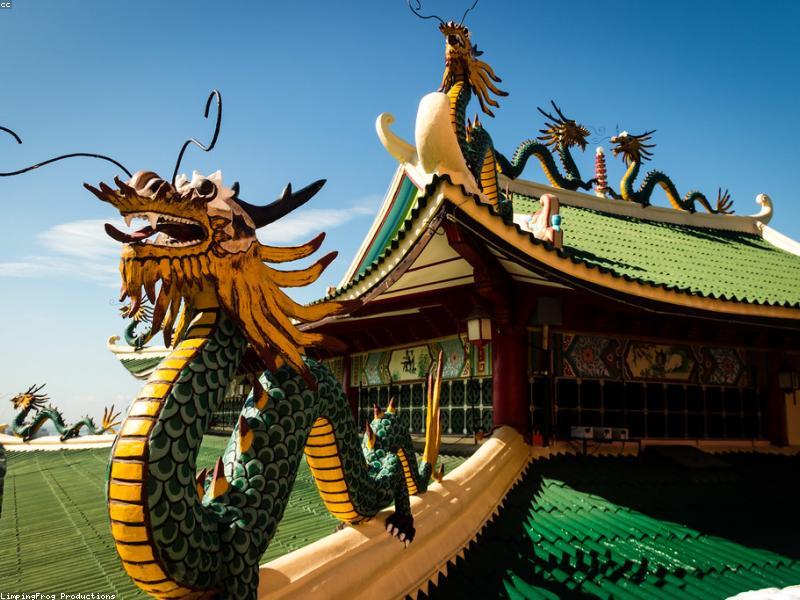
Temple roofs are among the most distinctive features of Chinese architecture. The curved, overhanging eaves serve both practical and symbolic purposes: they protect walls from rain, the upward curve is said to ward off evil spirits (which can only travel in straight lines), and the ceramic ridge decorations (often depicting dragons, phoenixes, and mythological figures) indicate the building's importance.
The Colors of Power
Color in Chinese architecture is not decorative — it is codified:
- Yellow/gold — Reserved for the emperor. Yellow roof tiles appear only on imperial buildings.
- Red — Symbolizes good fortune, happiness, and power. Used on palace walls, temple columns, and wedding decorations.
- Green — Represents growth and harmony. Used on buildings associated with scholars and education.
- Gray/white — Common in civilian architecture, especially in southern China. The white-walled, gray-tiled houses of Anhui province (Huizhou architecture) are iconic.
- Black — Used on libraries and study halls, as black represents water in the five elements and thus protection from fire.
The Forbidden City is a masterclass in color hierarchy: golden yellow roofs, red walls, white marble platforms, and blue-green painted details. Each color choice was dictated by imperial protocol, not personal taste.
The Bracket System (Dougong)
One of the most remarkable engineering features of Chinese architecture is the dougong (斗拱) bracket system. These interlocking wooden brackets connect pillars to the roof without a single nail. They distribute the roof's weight across the structure and allow buildings to flex during earthquakes — ancient Chinese wooden buildings have survived earthquakes that destroyed modern concrete structures.
The dougong system also has aesthetic significance. The number of bracket tiers indicates the building's importance. Imperial structures have the most elaborate brackets; civilian buildings use simpler versions.
North vs. South
Chinese architecture varies dramatically by region:
- Northern China — Thick walls for insulation, inward-facing courtyards, gray brick, and flat or gently sloped roofs. Beijing's siheyuan is the archetype.
- Southern China — Open, airy designs for ventilation in the humid climate. Anhui's Huizhou houses feature white walls and dramatic horse-head gables. Fujian's tulou (earthen roundhouses) are fortified communal structures housing entire clans.
- Western China — Tibetan architecture features thick stone walls, flat roofs, and Buddhist design elements. In Yunnan, Dai-style bamboo houses are raised on stilts to avoid flooding and insects.
Modern China and Preservation
Rapid urbanization has destroyed much of China's traditional architecture. Entire hutong neighborhoods have been bulldozed for apartment towers. The government now recognizes the loss and has designated preservation zones in cities like Beijing, Pingyao, and Lijiang.
Contemporary Chinese architects are also reinterpreting traditional forms. Wang Shu, who won the Pritzker Architecture Prize in 2012, uses reclaimed tiles and traditional techniques in modern buildings. His Ningbo History Museum incorporates rubble from demolished villages — a powerful statement about memory and loss.
The challenge for China is balancing preservation with the genuine need for modern housing and infrastructure. Traditional courtyard houses, beautiful as they are, lack modern plumbing and heating. Finding ways to honor architectural heritage while meeting the needs of 1.4 billion people is one of the great design challenges of our time.